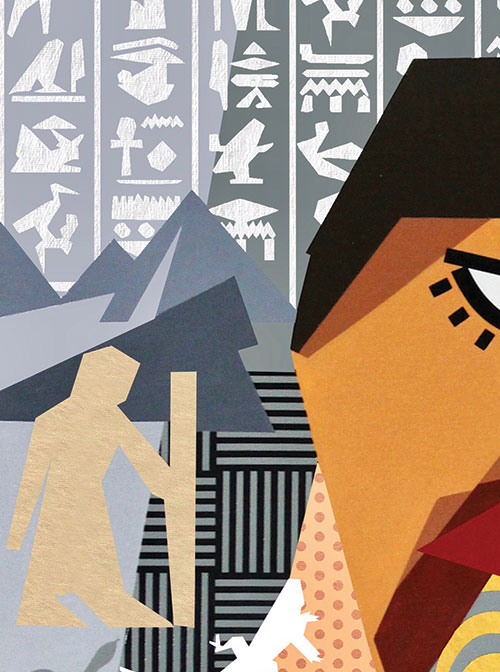
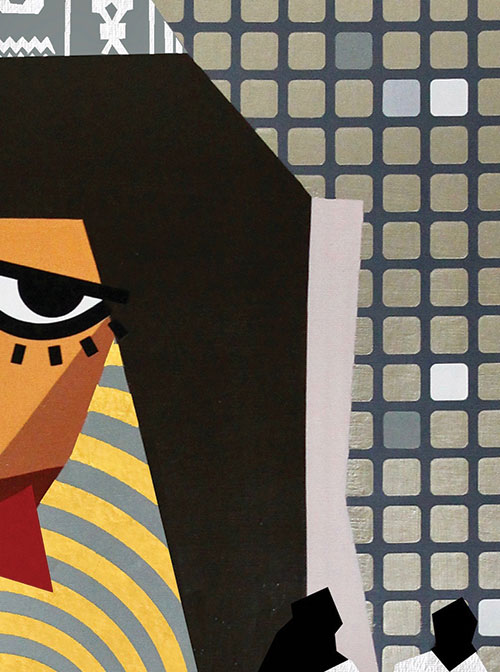

This painting explores memory, identity, and the relationship between the individual and the world around them. At the centre, a monumental female figure dominates the composition. Her angular face and contemplative gaze create a quiet sense of introspection, as though she is looking inward while the surrounding world continues to move around her.
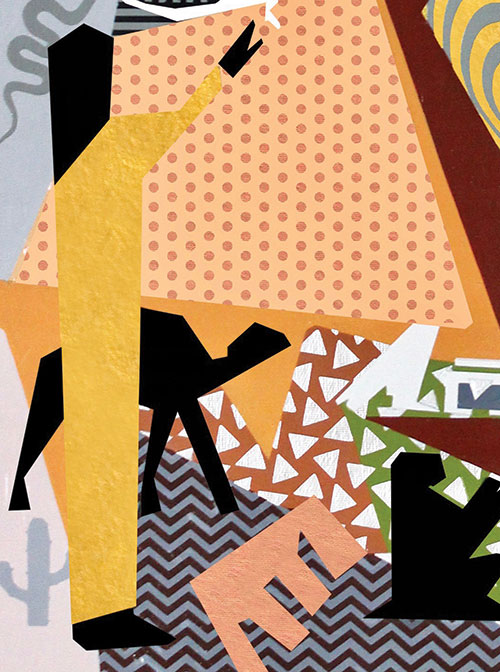
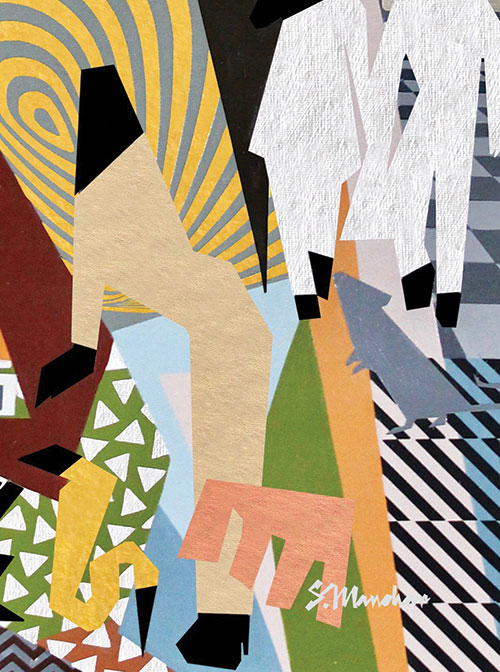
The figure is constructed from geometric fragments, bold colour fields, and contrasting patterns. Her clothing and body become a collage of dots, stripes, waves, triangles, and organic shapes. These patterns represent the many experiences that accumulate within a person over time—memories, encounters, emotions, and impressions that become inseparable from identity.
Around her, smaller human figures, architectural forms, trees, and abstract objects create a layered environment. The distant figures appear almost anonymous, suggesting the countless people who pass through our lives. Some become significant memories, while others remain only as fleeting silhouettes.
The background combines architectural and symbolic patterns, creating the impression of a city remembered rather than literally observed. The vertical structures and repeated motifs provide a sense of order, while the fragmented figures and overlapping forms introduce movement and uncertainty. The palette of terracotta, ochre, cream, muted blue, green, black, and white balances warmth with restraint. The strong black shapes give the composition visual weight, while the brighter patterned areas bring energy and rhythm.
The painting deliberately exists somewhere between portrait, landscape, and memory. The woman is not simply a portrait of a person; she becomes a vessel for the world around her. The surrounding figures and objects seem to emerge from her memories, creating a visual connection between inner experience and external reality.
At its heart, the work reflects on how identity is formed through fragments. We carry pieces of places, people, conversations, and experiences within us. With time, these fragments lose their literal details and become impressions—colours, shapes, patterns, and emotions.
The painting invites the viewer to look beyond the individual figure and consider their own collection of memories: the people who remain, the places that shaped them, and the moments that quietly became part of who they are.