
This painting explores the relationship between memory, place, and human experience, bringing together fragments of architecture, people, nature, and imagined spaces within a single composition.
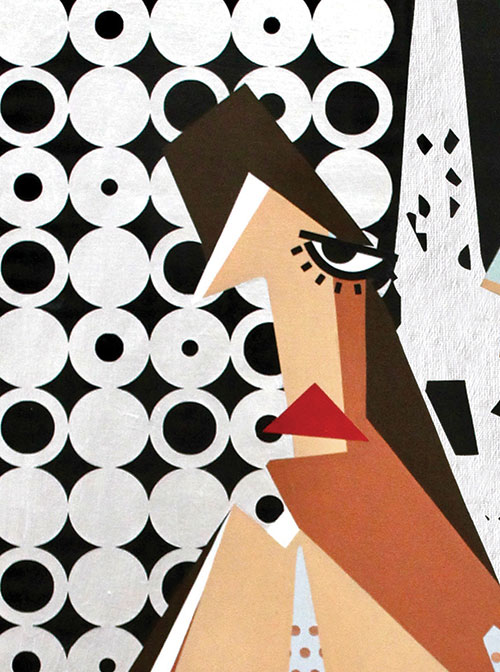
At the centre, the large female figure becomes the emotional anchor of the work. Her angular face, elongated form, and lowered gaze suggest a moment of introspection. She appears almost larger than her surroundings, as if she represents not only an individual but also the presence of memory itself—holding within her fragments of places and experiences from another time.
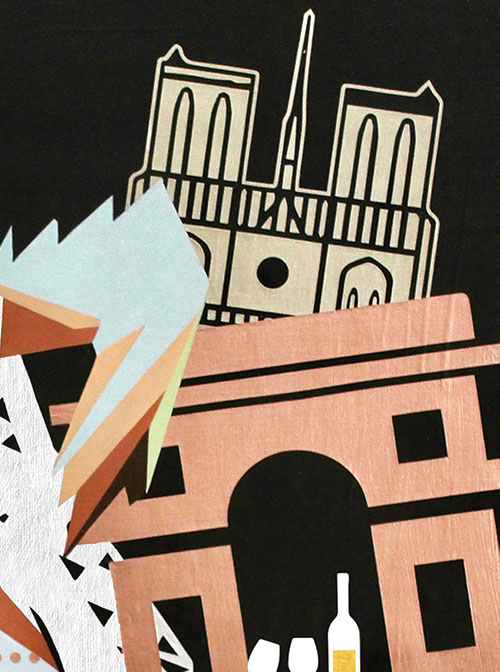
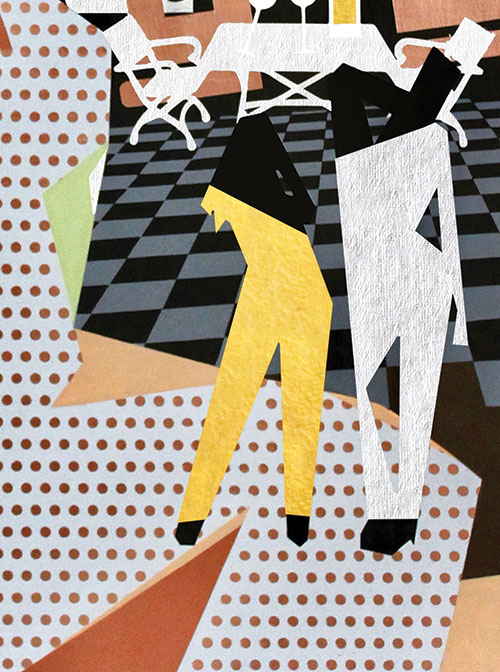
Behind her, the architectural forms suggest a historic European cityscape, while the smaller figures appear to move through the space as observers, visitors, or participants in everyday life. The architecture is deliberately simplified and fragmented, allowing it to function as a memory rather than a precise representation of a particular place.
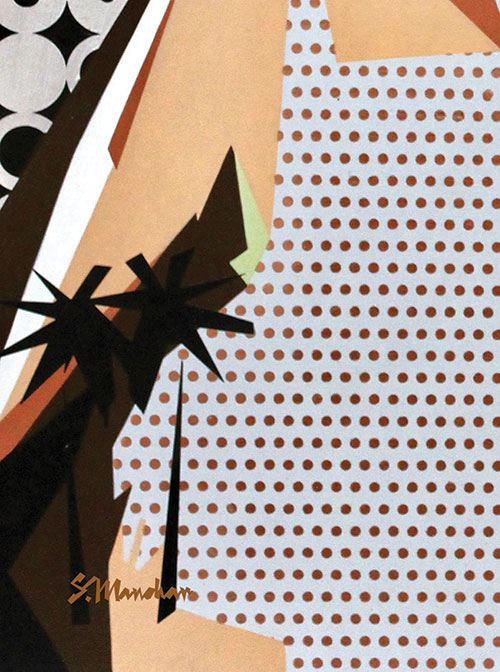
The painting is built from a strong contrast of geometric patterns and organic silhouettes. Circles, dots, checkerboards, triangles, and linear forms create a rhythmic surface, while the palm-like trees and human figures introduce softer, recognisable elements. These contrasting forms reflect the way memories are constructed—partly ordered, partly chaotic, and often incomplete.
The palette of terracotta, ochre, cream, black, white, and muted blue creates a warm yet nostalgic atmosphere. The bold black-and-white patterns provide structure and intensity, while the warmer tones bring a sense of human presence and emotional warmth.
The smaller figures within the composition are particularly important. They suggest that memory is not only personal; it is also connected to the places we visit, the people we encounter, and the environments that shape us. The figures seem to move through a world that is simultaneously real and imagined.