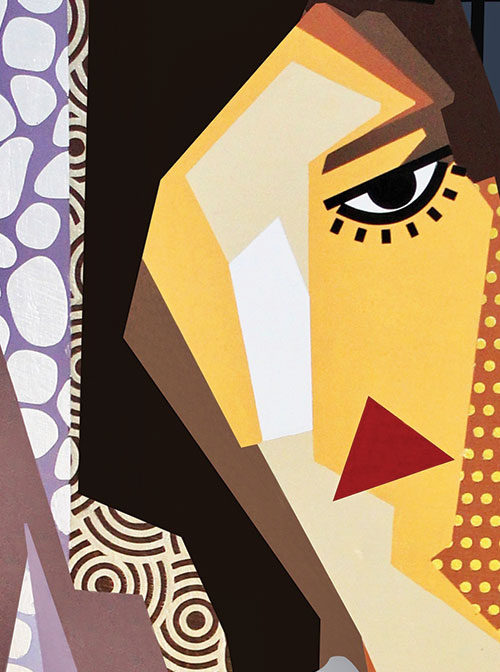
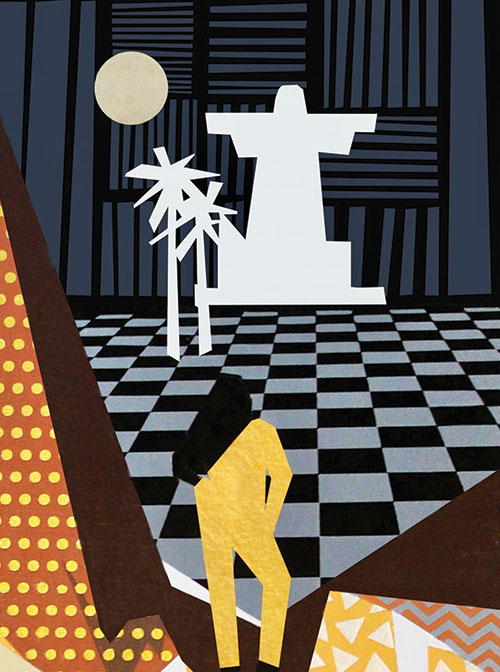
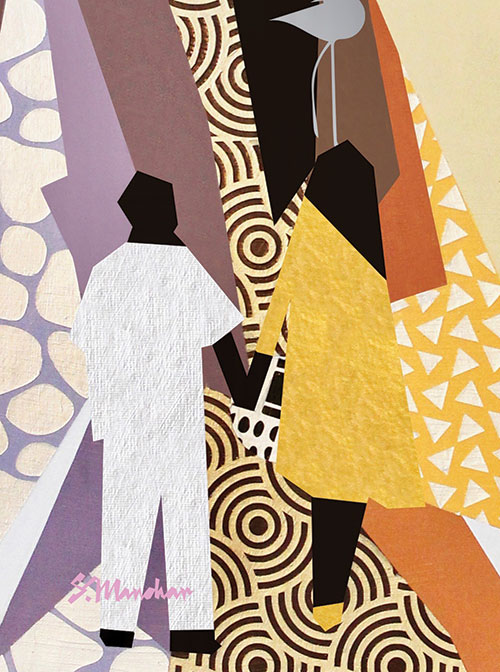
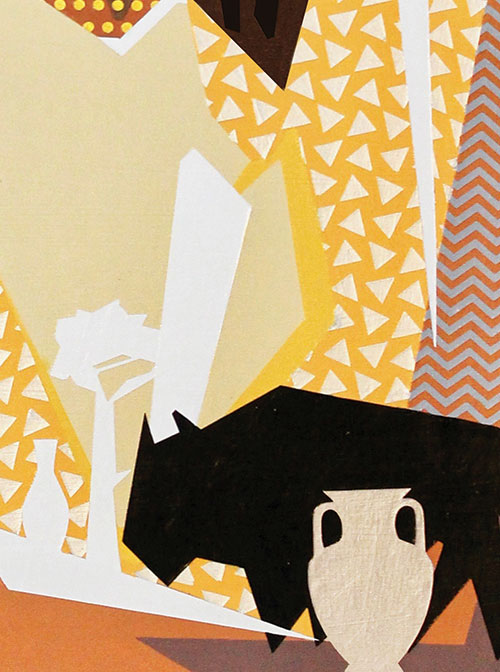

This painting explores the relationship between memory, place, and human presence. At the centre, a solitary woman occupies an imagined landscape where architecture, nature, and fragments of everyday life coexist in an almost dreamlike space.
The large figure dominates the composition, yet her simplified, angular face and patterned clothing suggest that she is less a specific person and more a vessel for memory. Around her, smaller figures, birds, trees, furniture, and architectural forms appear as isolated fragments—like images recalled from different moments and brought together in the mind.
The dramatic black-and-white floor and architectural backdrop create a sense of depth and movement, while the warm yellows, oranges, and earthy tones bring intimacy and emotion to the composition. Repeated circles, dots, triangles, and geometric patterns create a visual rhythm, echoing the way memories repeat, overlap, and transform over time.
The white monument-like form in the distance introduces a sense of permanence, contrasting with the transient human figures in the foreground. The small figures appear to move through this constructed world, suggesting journeys, encounters, and moments that are remembered only in fragments.
I have deliberately avoided realistic representation. The fractured forms and contrasting patterns allow the painting to function like a memory itself—recognisable in its elements, but rearranged by emotion and imagination.